


Home Stories: Marie Sagen / Aula


For this special Home Stories, we meet Marie Sagen, founder of Oslo-based studio Aula, and look at the different spaces that surround her work and everyday life.
At the centre is Marie’s own home — a light-filled family apartment shaped around the way she and her family live. It is here that we begin, exploring the objects, routines and architectural qualities that make a space feel like home.
From there, we step into Aula’s studio and workshop, where Marie works alongside her team, and visit a recently completed apartment designed by the studio. Together, the three spaces offer different perspectives on the same question that sits at the heart of Aula’s practice: how do we shape the spaces around us, and how do they, in turn, shape the way we live?
Founded in 2017 by anthropologist Marie Sagen and furniture designer and interior architect Sara Gretteberg, Aula works across interior architecture, product design and set design. An anthropological approach runs through their practice, with a particular interest in the relationship between people, objects and their surroundings.
Marie’s apartment
“Colour, material and form are all important, but what interests me most is the relationship between them and the atmosphere they create together.”
What makes a house feel like home?
There is something almost indefinable about the atmosphere of a home, you can often simply sense whether it is there or not. Perhaps that is also why it can be so difficult to create. It is something we often hear from our clients: they know how they want their home to feel, but struggle to define what is missing.
At Aula, we often break atmosphere down into the relationships between people, spaces and objects. How does the home function? What do you choose to surround yourself with? Does it make room for the routines, relationships and activities that are important to you? For me, a home begins to feel like home when there is a sense of belonging between you and your surroundings. We shape our homes, but our homes also shape how we move, gather, rest and live. When the two support one another, the home becomes more than a backdrop to your life – it becomes an active part of it.
Is there a space in your home you are drawn to the most — and why?
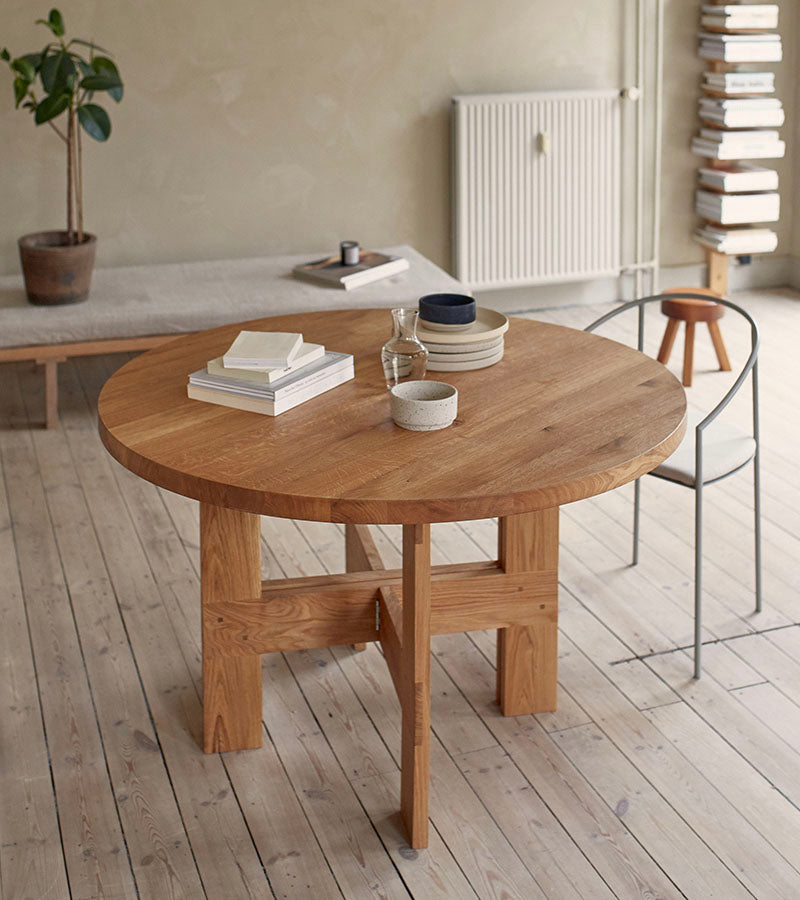
I think it would have to be the dining table. From there, I can see two of my favourite perspectives in the apartment: in one direction, through the kitchen towards my daughter’s bedroom, and in the other, through the TV room towards the main bedroom.
I love the layout and architectural qualities of the apartment, the windows, the layered rooms and the way the spaces open into one another. I also love that we have managed to fit so much “house” into a relatively small space. There is a closeness between the rooms that means you can be doing different things and still feel connected to one another.
When we worked on the kitchen and the small room connected to it, I often thought about my childhood at our cabin in the mountains. I remember waking up close to where my mother would make her morning coffee and listen to the radio. Nothing extraordinary was happening, but those small moments came to define a feeling of home for me. There was a closeness and a sense of safety that I still remember very clearly. I think, perhaps without fully realising it at first, I have tried to recreate some of that feeling here.
Which object best represents your daily life here?
Probably my baskets. I have collected baskets for many years, and some of my favourites have naturally found their way into our home, while the rest of the collection has slowly taken over the basement. I also weave baskets myself in our workshop, which makes them feel even more connected to my everyday life and work.
I like objects that are both useful and beautiful, and baskets are exactly that to me. I’m also drawn to the way they reflect different craft traditions and the very human act of making something by hand. They move around the apartment depending on what we need them for, so they become part of everyday life rather than objects that are simply there to be looked at.
Aula Studio


Marie’s relationship with objects extends beyond her own home. At Aula, she works with Sara Gretteberg and their team across interior architecture, product design and set design, approaching spaces through the relationship between people, objects and their surroundings.


The Composed Apartment


The same attention to how people live within a space is at the heart of Aula’s interior projects. In a recently completed apartment, the studio applied this approach to a home beyond their own — working with the existing architecture, materials, colours and details to create a space shaped around everyday life.
How does your work live within your home?
In a very literal way, my work is my home. My colleague Sara and I worked with the entire apartment – from the new floor plan to colours, materials, built-in elements and details.
Living here also means experiencing our own decisions over time, seeing how materials age, how spaces change and how the apartment adapts as our family does. I like that it is never really finished.
What defines an interior for you: colour, material, or form?
For me, it’s never one thing, but how everything comes together. Colour, material and form are all important, but what interests me most is the relationship between them and the atmosphere they create together.
I don’t think atmosphere is something you can add at the end. It emerges through the way all these elements relate to one another – through light, materiality, colour, function and the way a space is lived in. When those things work together, an interior begins to feel like a whole.
How would you describe your home to someone who cannot see it?
I would describe it as a light and airy family home, but also a warm and intimate one. We have tried to preserve and strengthen the architectural qualities of the original building while adapting it to the way our family lives today.
The rooms are layered, with long sightlines and daylight moving through the apartment, but there are also smaller spaces to withdraw to. We have used warm colours throughout, chosen to work with the changing light and seasons, especially through the long, darker months in Oslo.
As a family, we are gradually filling our home with books we love, art, baskets, objects we have collected and things made by the kids. Some things have been with us for years, while others have found their place more recently. I don’t really think of our home as something finished. It continues to change and take shape alongside us.
“We shape our homes, but our homes also shape how we move, gather, rest and live. When the two support one another, the home becomes more than a backdrop to your life – it becomes an active part of it.”